
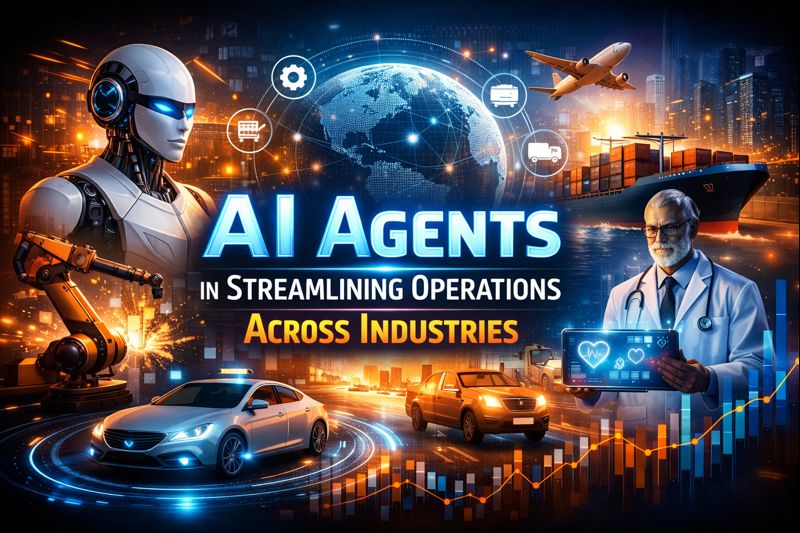
Artificial Intelligence (AI) is rapidly reshaping how businesses operate across various sectors. At the heart of this transformation are AI agents—autonomous systems designed to perform specific tasks, learn from data, and interact with their environment. These agents are driving operational efficiency, improving decision-making, and enabling automation like never before.
In this article, we explore the role of AI agents in streamlining operations across industries, focusing on real-world applications, emerging trends, and the benefits they offer. From customer service to supply chain management, AI agents are becoming indispensable tools in modern business practices.
What Are AI Agents?
Before diving into their applications, it’s important to define what an AI agent is. An AI agent is a software program or system that uses artificial intelligence technologies to perform tasks that would typically require human intelligence. These tasks include:
- Decision-making: AI agents can make informed decisions based on data, patterns, and algorithms.
- Automation: AI agents can automate repetitive tasks, freeing up human resources for more complex activities.
- Learning: Using machine learning, AI agents can improve their performance over time by learning from experience and feedback.
Many businesses are turning to an AI agent development company in the USA to create these intelligent systems, leveraging cutting-edge technology to drive efficiency and innovation. In essence, AI agents function as digital workers that can carry out a wide range of tasks autonomously, often with higher accuracy and speed than their human counterparts.
How AI Agents Are Streamlining Operations
AI agents are not just theoretical concepts; they are actively being integrated into business operations to achieve tangible results. Below are several ways AI agents are optimizing efficiency across different industries.
1. Enhancing Customer Support
Customer service is one of the most significant areas where AI agents are making a profound impact. Traditionally, customer support teams have relied heavily on human agents to handle inquiries, complaints, and service requests. However, AI-powered virtual assistants or chatbots are now capable of managing many customer interactions autonomously.
Key Benefits:
- 24/7 Availability: AI agents can provide support round-the-clock, ensuring that customer inquiries are addressed at any time.
- Faster Response Times: AI agents can instantly analyze and respond to customer queries, dramatically reducing response times.
- Personalization: Modern AI agents can tailor responses based on previous customer interactions and data, offering a more personalized experience.
Companies like Zendesk and Intercom are already leveraging AI agents to automate customer service, handle FAQs, and even provide advanced troubleshooting solutions. As a result, businesses can improve customer satisfaction while reducing operational costs.
2. Optimizing Supply Chain Management
Supply chain management is a complex, data-driven process that benefits immensely from AI agents. AI-powered systems can optimize everything from inventory management to logistics, helping businesses reduce inefficiencies and enhance the accuracy of their operations.
Key Benefits:
- Demand Forecasting: AI agents can analyze historical data, market trends, and external factors to predict demand and optimize inventory levels.
- Route Optimization: AI agents can recommend the most efficient delivery routes for logistics companies, reducing fuel consumption and delivery times.
- Predictive Maintenance: AI can predict when machinery or equipment is likely to fail, enabling businesses to perform proactive maintenance and reduce downtime.
For example, Amazon uses AI agents to manage its vast supply chain network, ensuring that products are stocked and delivered with optimal efficiency. The result? Faster delivery times and reduced operational costs.
3. Improving Human Resources (HR) and Talent Management
HR departments are increasingly turning to AI agents to streamline their recruitment and talent management processes. AI agents can handle the initial stages of recruitment by scanning resumes, conducting interviews, and even predicting a candidate’s potential success within an organization.
Key Benefits:
- Resume Screening: AI agents can quickly analyze resumes and applications, identifying the most qualified candidates based on predefined criteria.
- Candidate Engagement: AI-powered chatbots can interact with candidates throughout the recruitment process, answering questions and scheduling interviews.
- Employee Retention: AI systems can analyze employee data to identify potential signs of burnout or disengagement, enabling HR teams to take action before it’s too late.
IBM Watson is an excellent example of how AI is being used in HR. Watson’s AI-powered platform helps companies like Unilever and KPMG automate hiring processes, improving recruitment efficiency and reducing bias.
4. Boosting Healthcare Operations
The healthcare industry is another area where AI agents are playing a pivotal role in streamlining operations. From administrative tasks to patient care, AI agents are enhancing the efficiency and accuracy of healthcare delivery.
Key Benefits:
- Administrative Automation: AI agents can manage appointments, process insurance claims, and handle patient data, reducing the burden on administrative staff.
- Medical Diagnostics: AI-powered systems can assist healthcare professionals in diagnosing diseases by analyzing medical images, patient records, and other data sources.
- Patient Monitoring: AI agents can track patient vitals in real time, alerting healthcare providers to potential issues before they become critical.
PathAI is a company revolutionizing healthcare diagnostics with its AI agents. Their platform can analyze medical images with high accuracy, improving the speed and precision of diagnoses, especially in pathology.
5. Streamlining Financial Operations
In the finance industry, AI agents are transforming everything from fraud detection to portfolio management. Financial institutions are leveraging AI to enhance operational efficiency and provide better services to their customers.
Key Benefits:
- Fraud Detection: AI agents can continuously monitor financial transactions, identifying unusual patterns and flagging potential fraud in real-time.
- Portfolio Optimization: AI-powered systems can analyze market trends and make investment recommendations, optimizing portfolio performance.
- Customer Service Automation: AI agents are being used to automate routine banking inquiries, such as checking balances, transferring funds, or providing loan information.
JPMorgan Chase uses AI in its COiN platform to automate legal document reviews, which has resulted in significant time savings and improved accuracy in contract analysis.
6. Improving Marketing and Sales Strategies
AI agents are also making a significant impact in marketing and sales, enabling businesses to better understand customer behavior and tailor their strategies accordingly.
Key Benefits:
- Lead Generation: AI-powered chatbots and virtual assistants can engage potential customers, collect data, and qualify leads automatically.
- Personalized Marketing: AI systems can analyze customer data to deliver targeted advertising and personalized content, enhancing engagement and conversion rates.
- Sales Forecasting: AI agents can predict sales trends based on historical data and market conditions, helping businesses make more informed decisions.
Companies like Salesforce are using AI agents to provide predictive analytics, which help businesses identify the most promising leads and optimize sales strategies.
Challenges and Considerations
While AI agents offer numerous benefits, businesses must also be aware of the challenges involved in their integration.
1. Data Privacy and Security
AI agents require vast amounts of data to function effectively, which raises concerns about data privacy and security. Businesses must implement robust data protection measures to ensure compliance with regulations such as GDPR.
2. Integration with Existing Systems
Integrating AI agents into legacy systems can be complex and costly. Businesses need to carefully plan the implementation process to avoid disruptions.
3. Ethical Concerns
The use of AI in decision-making processes raises ethical concerns, particularly regarding bias and transparency. Businesses must ensure that their AI systems are fair, transparent, and accountable.
The Future of AI Agents in Business Operations
The role of AI agents in streamlining operations is only set to grow. As AI technology continues to advance, we can expect even more sophisticated agents that are capable of handling increasingly complex tasks across a broader range of industries. Key trends to watch include:
- AI and IoT Integration: The integration of AI with the Internet of Things (IoT) will enable more intelligent, autonomous systems that can act on real-time data to optimize operations.
- Human-AI Collaboration: Rather than replacing human workers, AI agents will increasingly collaborate with humans, enhancing productivity and creativity in the workplace.
- AI Ethics: As AI continues to evolve, ethical frameworks will be developed to ensure responsible AI use, balancing innovation with fairness and transparency.
Conclusion
AI agents are undeniably reshaping the landscape of business operations across industries. From automating customer support to enhancing supply chain efficiency, these intelligent systems are driving measurable improvements in productivity and decision-making. As AI technology continues to evolve, businesses that adopt these solutions will gain a competitive edge, improve operational efficiency, and unlock new growth opportunities.
By staying ahead of the curve and embracing AI-driven innovation, companies can harness the full potential of AI agents to streamline their operations and thrive in an increasingly automated world.



Leave a comment